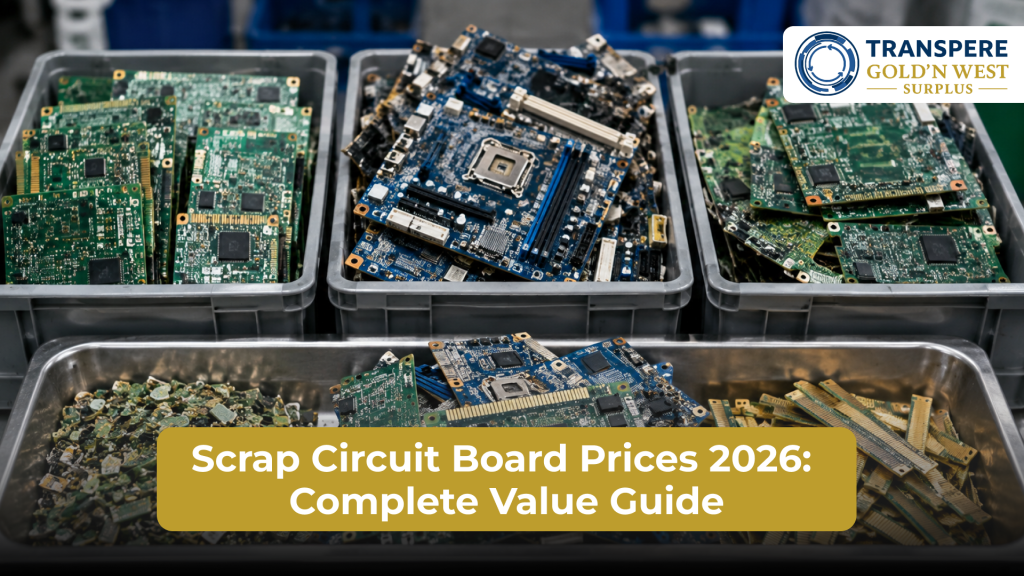
Scrap circuit board prices in 2026 range from about $0.15 per pound for low grade boards up to $10 or more per pound for high grade material, with gold rich items like clean gold fingers reaching $50 to $90 per pound on published buyer lists.
That is a huge spread, and it is the single most misunderstood thing about circuit board scrap value. Two boxes of boards that weigh exactly the same can differ in value by a factor of fifty. Here is where the market sits right now, compiled from U.S. buyer price sheets published and updated between February and April 2026:
| Board type or grade | Typical price range (per lb) |
| Low grade boards (power supplies, printers, monitors) | $0.15 to $1.15 |
| Mixed populated boards (small loads) | $0.29 to $0.58 |
| Mid grade boards (peripheral cards, routers) | $1.25 to $6.25 |
| Modern small socket motherboards | $1.25 to $3.15 |
| Vintage large socket motherboards (Pentium 3 era and older) | $3.00 to $10.00 |
| High grade boards (telecom, server) | $3.50 to $17.50 |
| Cell phone boards, clean | $14.00 to $24.00 |
| Hard drive boards | Up to $24.00 |
| Clean gold fingers (cut trim) | $50.00 to $90.00 |
| Gold plated RAM (memory) | Up to $58.00 |
A note on honesty here: these are ranges pulled from real, dated buyer lists, not promises. Every buyer grades a little differently, prices move with the metal markets daily, and a quote on your actual material is the only number that counts. That caveat applies to us too, which is why we quote from a photo or list before you ship or drive anything to us.
How Do Recyclers Grade Circuit Boards?
Circuit board grades are categories based on precious metal content, and they work a lot like the used car market: two sedans can weigh the same, but what is under the hood decides the price. In e-scrap, “under the hood” means gold, silver, palladium, and copper density.
• High grade boards come from telecom equipment, servers, and enterprise networking gear. They are densely packed with IC chips and gold plated connectors because that hardware was built for reliability, and gold is the best corrosion resistant conductor. Silver hides in the solder points and palladium in the multilayer ceramic capacitors, so a dense board pays on four metals at once.
• Mid grade boards are peripheral cards, sound and video cards, wireless router boards, and similar plug in hardware.
• Low grade boards live in power supplies, printers, monitors, and household appliances. They carry plenty of copper but very little gold, which is why they sit at the bottom of every price sheet.
• Populated vs. stripped matters too. A populated board still has its chips and capacitors attached. Shear components off, or leave heavy heatsinks and brackets on, and the buyer regards the load.
One more grading wrinkle that surprises people: age. Are old circuit boards worth anything? Often they are worth more than new ones. Boards built in the 1990s were manufactured when gold was cheap, so plating is thicker. That is why a Pentium 3 era large socket motherboard fetches roughly triple the motherboard scrap price of a modern small socket board on early 2026 buyer sheets ($10.00 versus $3.15 per pound on one list dated February 9, 2026).
Which Circuit Boards Have the Most Gold?
Gold drives the top of the market, and it concentrates in three places: the gold fingers (edge connectors that plug into slots), the pins on CPUs and headers, and the microscopic bond wires inside IC chips. The more chips and the thicker the plating, the higher the per pound value.
To put the concentration in perspective, recyclers commonly cite that a ton of circuit boards contains 40 to 800 times more gold than a ton of mined gold ore. That is the entire economic engine of this industry: it is simply cheaper to recover gold from e-waste than to dig it out of the ground, and our precious metal recovery program exists for exactly that reason.
The gold hierarchy in practice:
1. Cut gold fingers top the charts at $50 to $90 per pound on published 2026 lists, because they are nearly pure connector plating with no board weight attached.
2. CPUs are the wildcard. Ceramic processors run around $12 per pound, while rare vintage chips like the Intel 386 and 486 have been listed as high as $205 per pound.
3. Telecom and server boards are the volume play: not as rich per pound as fingers, but they arrive by the pallet.
4. Cell phone boards punch far above their size, with clean boards listed between $14 and $24 per pound in 2026.
We will be straight with you on one point: if you are holding a few motherboards from an old home PC, do not expect a windfall. A typical desktop motherboard nets a few dollars. The value story changes completely at business volume, where a few hundred decommissioned workstations can offset a meaningful chunk of an IT refresh.
Why Do Scrap Circuit Board Prices Change So Often?
A circuit board is priced like a tiny commodity portfolio. Its value tracks the metals inside it the way a fund tracks its holdings, so when the underlying metals move, board prices move with them. Four forces do most of the work:
Precious metal spot prices. Gold is trading around $4,050 to $4,100 per ounce as of this writing, according to Trading Economics, holding in the elevated range that has defined 2026 so far. Copper, meanwhile, hit a new all time high the same week per the iScrap App’s latest 2026 weekly market report. High spot prices flow directly into stronger board payouts, especially for high grade material.
Volume. Buyers publish two tiers: LTL (less than truckload) for small batches and TL (truckload) for bulk. The spread can be dramatic. One published 2026 example prices populated boards at $0.29 per pound for small loads and $0.58 per pound at truckload volume, double the rate purely for scale, because processing cost per pound drops.
Contamination. Batteries, heavy aluminum heatsinks, steel brackets, and attached cables all count as dead weight. Buyers downgrade contaminated loads or charge sorting fees, and coin cell batteries left on boards can get a load refused outright for environmental handling reasons.
Refining economics. Recovery rates, smelter terms, and freight all shift what a recycler can pay. This is the invisible layer most sellers never see, and it is why two buyers quoting the same day can land 20 percent apart on identical material.
How Do You Get the Best Price for Scrap Circuit Boards?
Preparation moves you from “mixed scrap” money to “graded material” money. If you want to sell scrap circuit boards at the top of the range, an afternoon of sorting is the highest paid work in this business. We would rather see you spend that afternoon than lose half your payout to a lowest common denominator price on a mixed pile.
1. Sort by grade. Never mix $10 per pound motherboards with $0.15 per pound power supply boards. Mixed loads get paid at or near the bottom grade.
2. Pull the CPUs and RAM. Both are worth several times more per pound than the board they sit on. Selling a motherboard with the processor and memory still attached leaves money on the table.
3. Remove every battery. CMOS coin cells are the most common load killer. Some buyers dock the price; others refuse the shipment.
4. Strip heatsinks and brackets. Aluminum and steel have their own scrap value, but attached to a board they just drag the grade down.
5. Leave gold fingers intact unless you know your buyer’s rules. Some price sheets pay a premium for cut trim, but poorly cut or devalued fingers get downgraded. For most sellers, clean whole cards graded honestly beat amateur harvesting.
One honest limitation: this level of prep pays off for recurring sellers and business loads. If you have a single tower in the garage, skip the disassembly, bring it in whole, and let the facility grade it. The labor math does not favor DIY at small scale.
Where Should You Sell Scrap Circuit Boards?
You have three realistic channels, and they are not equal.
General scrap yards focus on steel, copper pipe, and aluminum. Many will take boards but pay a flat rate near the bottom of the market because they cannot assay e-scrap properly. The iScrap App’s national reference price for generic PC boards sits at $1.65 per pound, which is fine for a mixed pile but badly underpays graded high value material.
Mail in programs work if you are far from a specialist, but read the fine print: lot minimums (commonly $150 in material) and shipping costs eat into small payouts.
Specialist e-waste recyclers grade by category, pay against current metal markets, and handle the compliance side. That is our lane, and it is where circuit board recycling stops being disposal and starts being a revenue line. Gold’n West Surplus has been buying and recycling boards in California since 1993, and our circuit board and component recycling program handles everything from single drop offs to nationwide pallet volumes, with R2v3 and ISO certified processing behind every payout.
Here is how it works with us: send a quick list or photo of your boards for a market based quote, then choose a drop off at our Corona facility or a scheduled business pickup. Payment is issued on the spot for most loads, or within 3 business days for larger ones. Smaller mixed loads can also go through our e-waste recycling by the pound program, which pays instant value on sorted or mixed material.
You can verify us before you sell: we are R2v3 certified, ISO 14001 and ISO 45001 certified, and WBENC and NMSDC certified as a woman owned and minority owned business. Find us at 1691 N. Delilah St, Corona, CA 92879, or call (951) 371-2020.
Frequently Asked Questions About Circuit Board Scrap Value
Are old circuit boards worth anything?
Yes, and older often means more valuable. Boards from the 1990s and earlier carry thicker gold plating than modern equivalents. Even low grade boards have copper value, though it may only be $0.15 to $1.15 per pound.
How much is a motherboard worth in scrap?
On early 2026 buyer sheets, modern small socket motherboards list between $1.25 and $3.15 per pound, while vintage large socket boards reach $3.00 to $10.00 per pound. A single desktop motherboard weighs roughly a pound, so think in the single dollars per board, more if the CPU and RAM are sold separately.
Do circuit boards really contain gold?
They do. Gold sits in edge connectors (gold fingers), CPU pins, and the bond wires inside IC chips. Concentrations are small per board but high per ton, which is why recyclers cite boards as containing 40 to 800 times more gold than equivalent gold ore.
Can you sell circuit boards without sorting them?
You can, but expect the mixed load rate, which prices everything at or near the lowest grade in the pile. Sorting by grade before you sell is the single biggest payout lever available to you.
Does Gold’n West Surplus buy circuit boards from outside California?
Yes. Local drop offs happen at our Corona, CA facility, and we arrange business pickups and inbound freight for commercial volumes nationwide. Start with a photo or list of your material and we will quote it against current market pricing.