
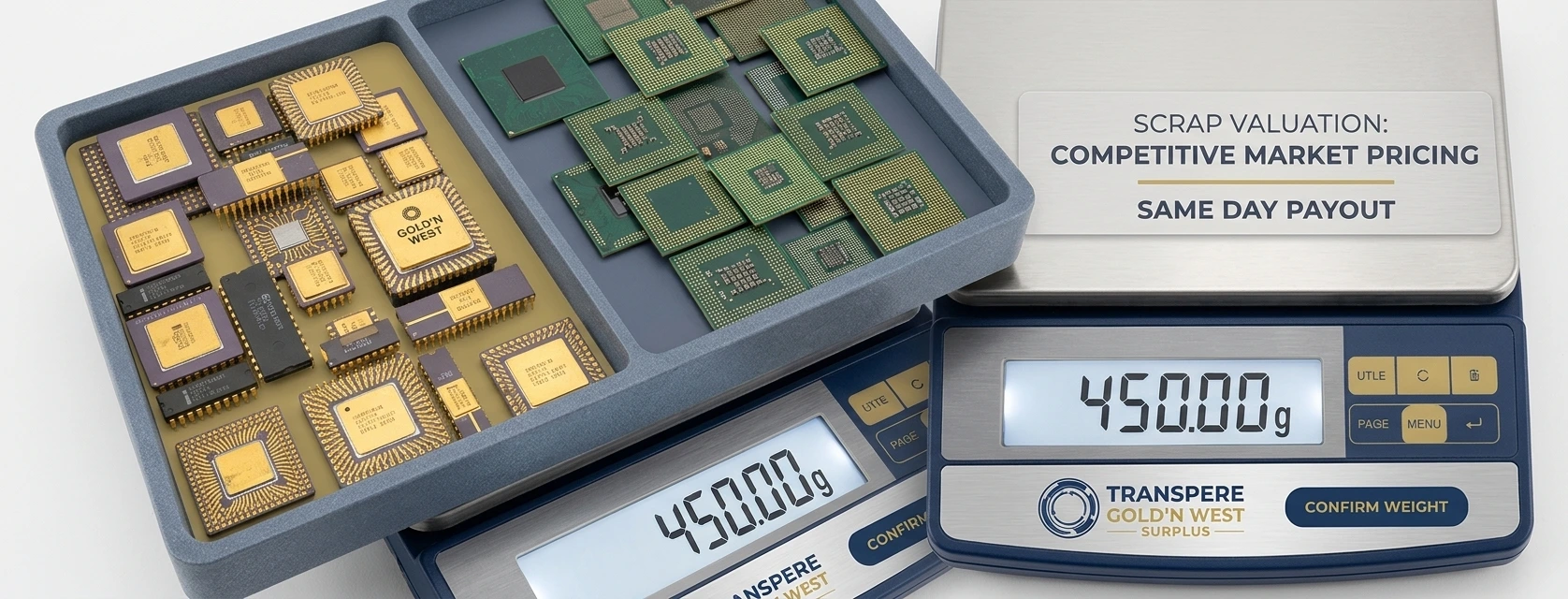
What you need to know in 30 seconds
- The best place to sell old CPUs for gold recovery is a certified electronics processor or specialist CPU buyer that pays by grade.
- Sorting is the whole game. One New Jersey yard posts $4.00 per pound for unsorted CPU chips but up to $130 per pound for gold one side ceramics.
- Vintage ceramic chips (Intel 386, Intel 486, Pentium Pro) pay the most. Modern pinless chips pay the least.
- Check sold listings before scrapping rare chips. Some are worth more to collectors.
- Skip pawn shops, jewelry stores, and home refining.
If you’re trying to figure out where to sell old CPUs and processors for gold recovery, the answer depends on two things: what grade of chips you have and how many pounds. A coffee can of mixed processors and a pallet of sorted ceramics belong with very different buyers.
We recover precious metals from electronics in Corona, California, and we see the same mistake every week. People sell good chips at bad prices because they sold them unsorted, to the wrong buyer.
Where is the best place to sell old CPUs for gold recovery?
The best place to sell scrap CPUs is a specialist buyer that grades processors into separate price tiers and pays against current metal markets. That usually means a certified electronics recycler with refining relationships, or a mail-in CPU buyer. General scrap yards and pawn shops pay far less because they lump everything together.
Here’s our opinion, stated plainly: we’d skip pawn shops and jewelry buyers entirely. A few guides suggest them, but those counters test rings and coins. They aren’t set up to grade a Pentium Pro against a green fiber Core i5.
What are your options for selling scrap CPUs?
Your options for selling scrap processors fall into six groups, and each fits a different seller.
| Buyer type | Best for | Typical pay level | Main catch |
|---|---|---|---|
| Certified e-scrap processor | Sorted or bulk CPUs, business loads | High, priced by grade | Get grading details in writing |
| Mail-in CPU buyer | Sellers far from a specialist | High for sorted lots | Shipping risk, minimum weights |
| eBay and collectors | Rare or clean vintage chips | Can beat scrap value | Fees, slow, account risk |
| ITAD reseller | Working, recent CPUs | Resale value, not scrap | Minimum order values |
| Local scrap yard | A handful of mixed chips | Low, one blended price | Little or no grading |
| Pawn shop or jeweler | Nobody | Lowest | Not equipped to grade e-scrap |
Certified electronics processors
A certified electronics processor sorts, grades, and sends material to refining, so it sits closest to where the gold is actually recovered. Fewer middlemen means more of the metal value reaches you.
Look for R2v3 certification. Sustainable Electronics Recycling International (SERI) published R2v3 in July 2020 as a voluntary responsible recycling standard, and you can verify any facility in SERI’s public directory. Our guide on where to sell scrap circuit boards has the full buyer vetting checklist.
Mail-in CPU buyers
Mail-in buyers publish per-pound prices by grade and pay after they receive and check your shipment. They work well when no specialist is nearby.
Read the terms first. Rockaway Recycling in New Jersey gives a free shipping label only when you send at least 1 pound of one material, and it honors quotes for 10 business days.
Cash for Computer Scrap in Ohio requires prior approval and a verified lot value of at least $150 for parcels, per its February 2026 price list.
eBay and collectors
Collectors sometimes pay more than any refiner. A moderator on the Gold Refining Forum told one seller to check collectible values before refining, since some chips are worth far more than the metal inside.
Picture a box of old baseball cards. Most are worth the cardboard, but one rookie card pays for the box. Pull the clean, rare chips first, then scrap the rest.
ITAD resellers and local yards
An ITAD company (IT asset disposition, a firm that buys and resells used business hardware) pays for working processors as parts, not metal. exIT Technologies says its minimum is about $1,000 in resale value. For working business hardware, see our IT asset disposition service.
Local scrap yards usually post one blended CPU price. ScrapMonster’s national survey showed a yard average of $4 per pound for CPU scrap as of March 9, 2026. That’s fine for three or four chips, not for a real collection.
How much do scrap CPU buyers pay right now?
Scrap CPU buyers currently pay from about $4 per pound for unsorted chips to $350 per pound or more for sorted vintage ceramics. Here are two real, dated price lists side by side.
| CPU grade | Rockaway Recycling (posted Nov. 2026) | Cash for Computer Scrap (effective Feb. 9, 2026) |
|---|---|---|
| Intel 386 and Intel 486 ceramic | Gold one side ceramic: $110 to $130/lb | $350/lb |
| Pentium Pro gold cap | Gold one side ceramic: $110 to $130/lb | $240/lb |
| Pentium or AMD ceramic | Ceramic with aluminum back: $28 to $30/lb | $105/lb |
| Black fiber | $35/lb | $110/lb |
| Green fiber with pins | Plastic with gold pins: $7.00 to $8.25/lb | $18/lb (heatsink on) |
| Pinless modern chips | Copper back, flat pins: $4.00 to $5.50/lb | $13/lb |
| Unsorted CPU chips | $4.00/lb | Must be sorted |
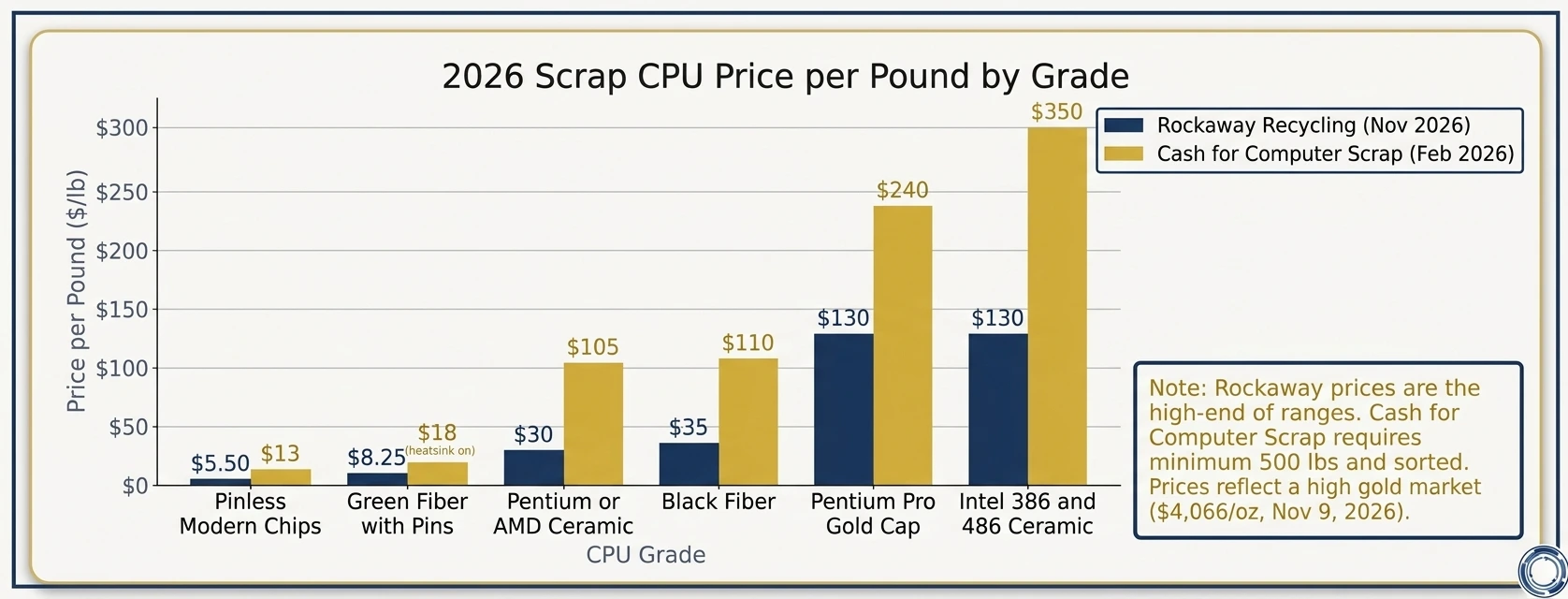
The two lists name grades differently, so we matched them by their descriptions. Cash for Computer Scrap’s prices also apply to freight lots delivered to its dock, which generally means a 500 pound minimum.
Gold closed at $4,066 per ounce on November 9, 2026, according to ISA Bullion’s daily market report. CPU prices follow that number, so expect any list to drift week to week.
Have a bin of processors? Gold’n West Surplus has recycled electronics for over 30 years from our R2v3 certified facility in Corona, California. Send a photo or list through our precious metal recovery program and we’ll quote it by grade, usually the same day.
Why does sorting change the price so much?
Sorting changes the price because a buyer quoting a mixed bucket has to assume the worst chips are in it. Separate the grades and each pile earns its own rate.
Think of a jar of loose change. A coin machine pays face value. Pull out the old silver quarters first and they sell for their metal, not 25 cents.
Rockaway’s list proves it: $4.00 per pound for unsorted CPU chips, up to $130 for gold one side ceramics. Ten pounds of ceramics sold mixed could lose over a thousand dollars.
Sort into at least these piles:
- Gold cap and gold one side ceramic: Intel 386, Intel 486, Pentium Pro, older Cyrix and IBM chips.
- Plain ceramic: grey or brown bodies, aluminum or copper backs.
- Black fiber: dark substrate, often late 1990s.
- Green or brown fiber with pins: Pentium 4, Athlon, early Core chips.
- Pinless: modern chips with flat contact pads.
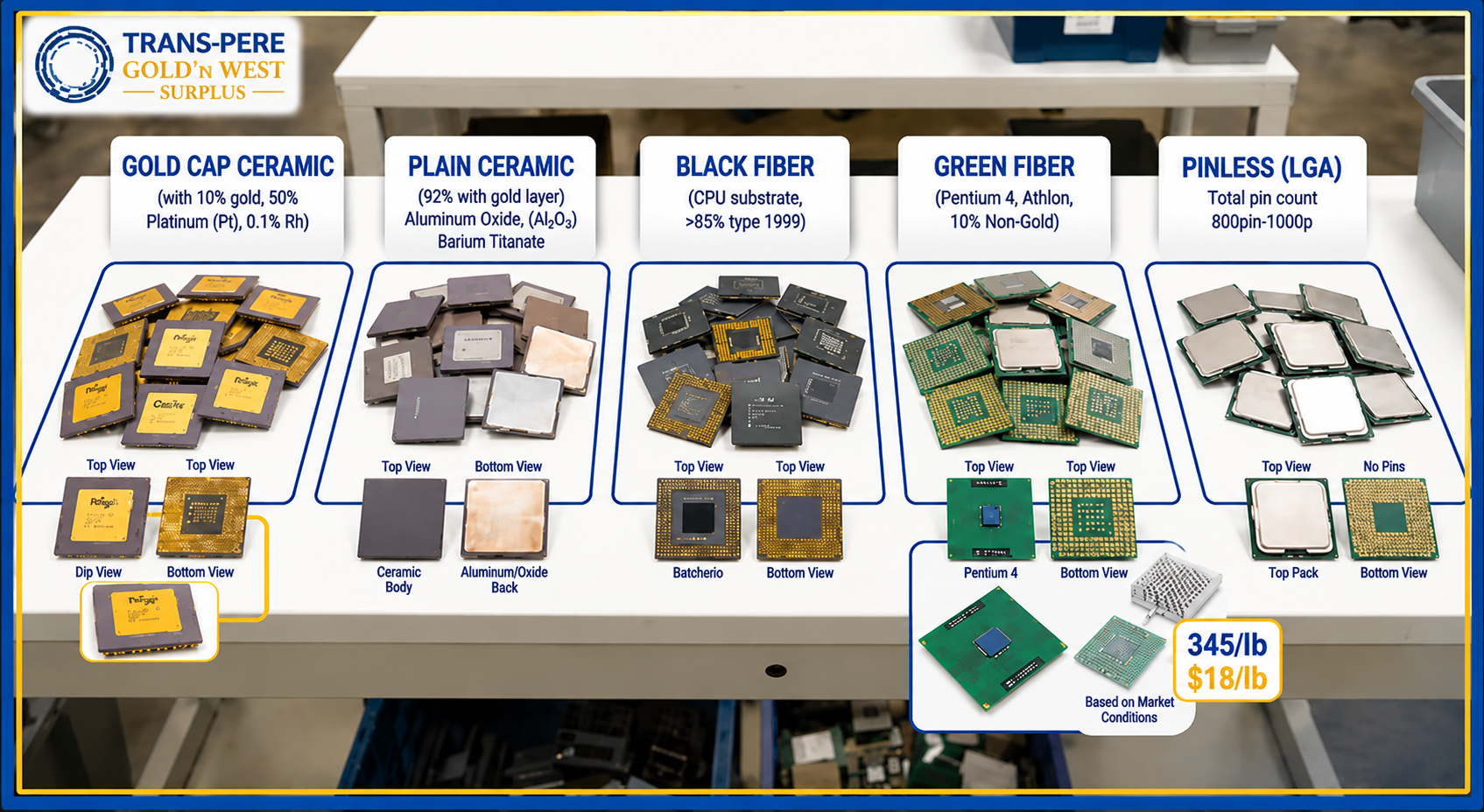
Pull heatsinks off too. Cash for Computer Scrap pays $45 per pound for green fiber CPUs without a heatsink, but only $18 with it on.
Why do buyers pay less than the gold inside?
Buyers pay less than the contained gold because refining costs money. Acid, labor, fume control, assay, and waste disposal all come out before anyone writes a check.
Here’s the math from one real lot. A Gold Refining Forum seller estimated that 130 ceramic CPUs, about 3 kilograms, held 16 to 18 grams of gold, or roughly two and a half grams per pound.
At $4,066 per ounce, that’s about $315 to $355 of gold per pound. Published buyer prices for similar chips run about $105 to $350 per pound.
Should you refine CPU gold yourself instead of selling?
For almost everyone, no. Home refining means nitric acid, aqua regia, and toxic gases, and that same forum seller described inhaling nitrogen oxide fumes after a respirator failed.
There’s a legal side too. California’s Department of Toxic Substances Control classifies e-waste as universal waste, a type of hazardous waste, and the Department of Toxic Substances Control also says smashing e-waste is illegal.
The honest caveat: experienced refiners with real ventilation and a gold buyer can do better on big ceramic lots. That seller said his buyer pays about 95 percent of spot. If that isn’t you, sell the chips.
How do you sell old CPUs for gold, step by step?
Sell old CPUs for gold by sorting, pricing, and quoting before you ship anything. This works for a shoebox or a pallet.
- Pull collectibles. Set aside clean, rare, or boxed chips and check sold listings.
- Strip and sort. Remove heatsinks and fans, then sort into the five piles above.
- Weigh each pile. A kitchen scale is fine for small lots.
- Get two or three quotes. Send top and bottom photos of each grade, plus weights.
- Compare net payout. Subtract shipping, minimums, and payment fees.
- Ship or drop off. Keep photos and a packing list as your record.
- Check the grading sheet. A lump sum with no per-grade rates is a red flag.
Local sellers can bring sorted chips to our Corona drop-off location with no appointment. Businesses with volume can schedule a pickup.
If sorting isn’t worth your time, our e-waste recycling by the pound program takes mixed loads.
If the chips came from company PCs, handle the drives first with our data destruction service.
Frequently asked questions
Can you sell old CPUs at a pawn shop or jewelry store?
You can try, but you’ll rarely get a fair price. Pawn shops and jewelers price gold in solid items like rings and coins. A CPU holds a small fraction of a gram of gold spread through ceramic and pins, so they either refuse it or lowball it. An electronics recycler is the right buyer.
What CPUs are worth the most for scrap gold?
Vintage ceramic processors are worth the most. On Cash for Computer Scrap’s February 2026 list, Intel 386 and Intel 486 chips pay $350 per pound and Pentium Pro gold caps $240. Motorola ceramics list even higher, at $390. Modern pinless chips sit at the bottom, around $13 per pound.
How many CPUs do you need to sell for scrap?
Most mail-in buyers want at least 1 pound of a single grade, and freight programs often want hundreds of pounds. Rockaway Recycling’s free shipping starts at 1 pound per material. About 20 ceramic chips weigh a pound, so even a small collection can qualify once it’s sorted.
Is it worth selling modern CPUs for scrap?
Modern CPUs are worth scrapping only when they’re dead or obsolete. Working chips from the last few years sell for far more as used parts. Dead modern chips pay roughly $4 to $18 per pound depending on pins and heatsinks, so they make the most sense bundled with other e-scrap.
Do scrap CPU prices change with gold prices?
Yes. Scrap CPU prices track gold, with silver, palladium, and copper playing smaller roles. Gold closed at $4,066 per ounce on November 9, 2026, after a one-year low near $3,870 in late October. Reputable buyers update their lists often, so always ask for a dated quote.
The bottom line on where to sell old CPUs
The best place to sell old CPUs and processors for gold recovery is a certified buyer that grades by chip type and pays on current metal prices. Sort first, pull the collectibles, get more than one quote, and never sell a bin of ceramics at the unsorted rate.
Ready to see what your processors are worth? Request a quote from Gold’n West Surplus at 1691 N. Delilah St, Corona, CA 92879, or call (951) 371-2020.
Prices in this guide come from buyers’ published lists as of the dates shown and change often. They are not a Gold’n West Surplus price offer.