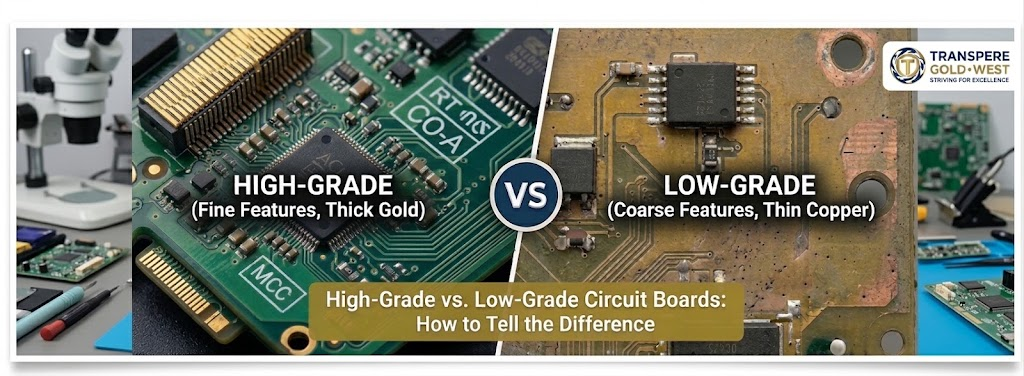
Two boards can weigh exactly the same and be worth wildly different amounts. A server motherboard and a microwave control board are both printed circuit boards (PCBs), but a refiner sees one as a concentrate of gold, silver and palladium and the other as mostly fiberglass, copper and solder.
The difference between high-grade and low-grade circuit boards comes down to how much precious metal sits on the board, and you can estimate that with your eyes before anything is weighed. This guide shows you how.
| Quick answer: A high-grade circuit board is densely populated with integrated circuits, BGA chips and gold-plated edge connectors, and usually comes from servers, telecom or industrial equipment. A low-grade circuit board is sparsely populated, often brown or single-sided, carries heavy transformers or heatsinks, and comes from consumer electronics and appliances. |
Gold’n West Surplus has bought and recycled scrap boards at our Corona, California facility since 1993. What follows is the visual triage our team uses on the floor.
What is the difference between high-grade and low-grade circuit boards?
The main difference between high-grade and low-grade circuit boards is precious metal concentration per pound. High-grade boards carry far more gold, silver and palladium in their connectors, chips and capacitors. Low-grade boards are mostly substrate, copper traces and bulky parts that add weight without adding much value.
Think of it like mining ore. Two trucks of rock can weigh the same, but the truck from the rich vein is worth more because of what is locked inside, not because of how heavy it is.
That precious metal lives in three main places:
- Gold-plated contacts: edge connectors (often called gold fingers), socket pins and plug contacts.
- Integrated circuits (IC chips): many chips use fine bond wires, traditionally gold, to connect the silicon die to the package leads.
- Ceramic capacitors: older multilayer ceramic capacitors often used palladium and silver in their internal electrodes.
Equipment origin explains the gap. Servers and telecom switches were built to run nonstop for years, so they got corrosion-resistant gold plating and dense chips. A budget printer was built to be cheap.
If you want to see how these grades translate into payouts, our scrap circuit board price guide covers current value ranges in detail.
How do you tell if a circuit board is high grade?
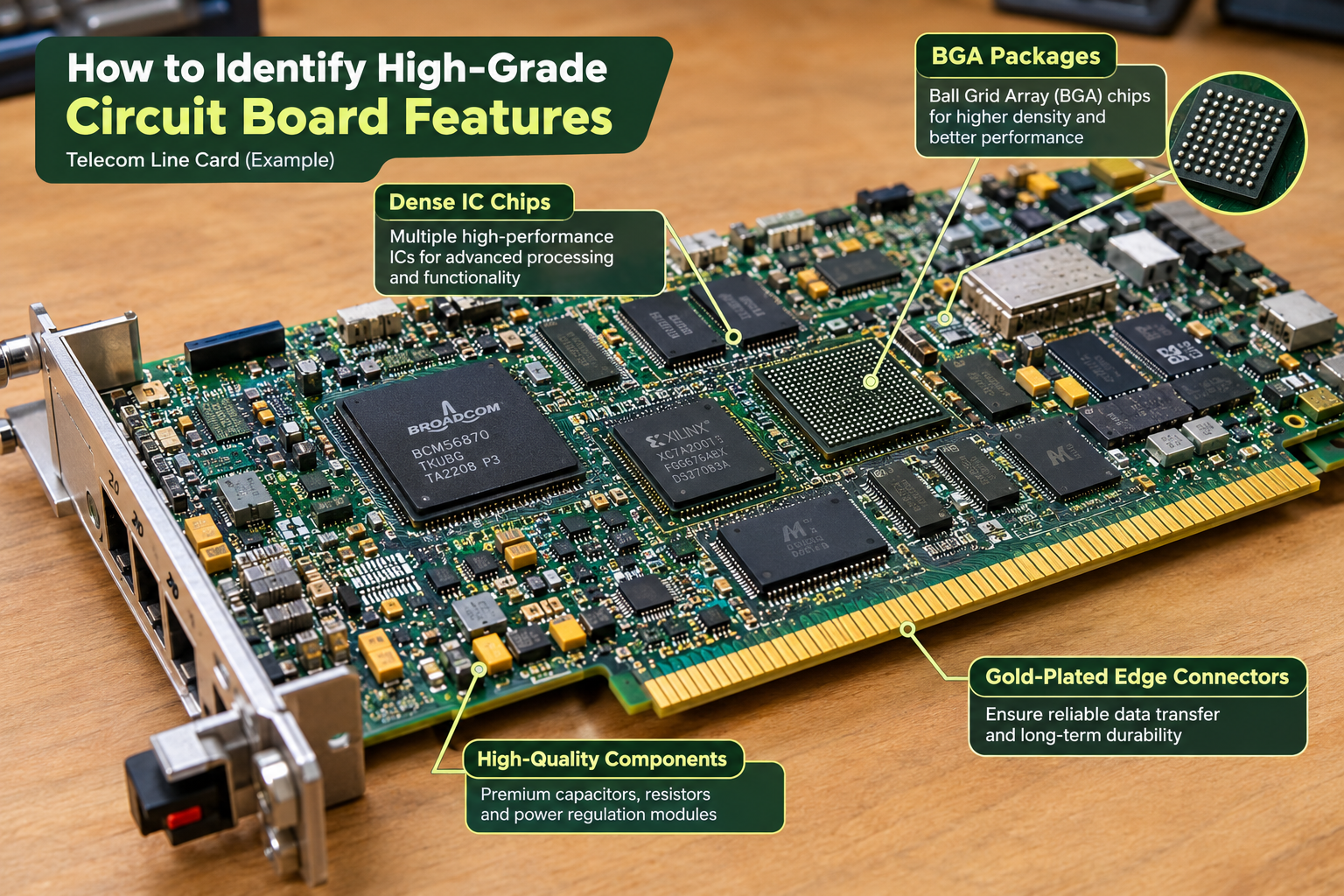
You can tell a circuit board is high grade by checking seven visual signals: equipment origin, chip density, BGA chips, gold on the connectors, processor type, layer count, and how much non-board weight is attached. Most high-grade boards hit at least four of these at once.
Here is the checklist our sorters use:
- Equipment origin: Server, telecom, networking, medical and military or aerospace hardware almost always yields high-grade boards.
- Component density: Chips, resistor arrays and capacitors cover most of the surface.
- BGA chips: Ball Grid Array packages are flat, square chips soldered by a grid of tiny balls underneath instead of visible legs. Several of them on one board is a strong high-grade signal.
- Gold on connectors: Bright, even yellow plating on edge fingers, sockets and backplane connectors. Check under good light, since thin gold and polished copper look alike at a glance.
- Processor type: Server-class processors such as Intel Xeon or AMD EPYC sockets point to higher grades than budget consumer chips.
- Layer count: Look at the board edge. Thick multilayer boards typically carry more metal than thin single-layer ones.
- Little dead weight: No large steel brackets, transformers or oversized aluminum heatsinks diluting the weight.
We’d sort by origin first, not by color. Here’s why: origin tells you how the board was engineered, and the engineering budget is what put the gold there in the first place.
What does a low-grade circuit board look like?
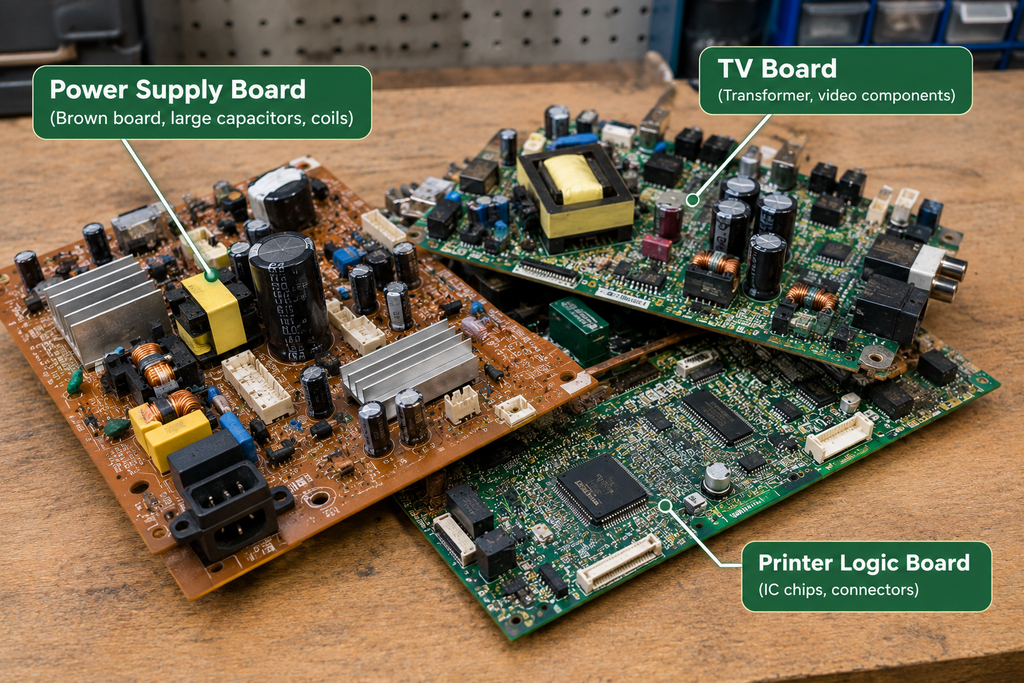
A low-grade circuit board looks sparse. You see wide stretches of bare board, a handful of through-hole parts, and bulky components such as transformers, large electrolytic capacitors, relays and heatsinks.
Common low-grade sources include:
- Power supply boards: ATX power supplies, chargers and wall adapters.
- Display boards: TV and monitor power and driver boards.
- Printer and scanner boards: built for low cost, with minimal gold.
- Appliance boards: microwaves, washers, HVAC controls and toys.
Many low-grade boards use brown or tan phenolic substrate (layered paper bonded with resin) instead of green fiberglass. That color clue is useful, but as the next sections explain, it is far from reliable.
Low grade does not mean worthless. These boards still hold copper and some precious metal, and in California they should never go in the trash.
Where do mid-grade circuit boards fit?
Mid-grade circuit boards are the middle tier: desktop and laptop motherboards, video cards and network cards. They show moderate chip density, some gold on slot connectors, and visible bare board between components.
Most of what comes out of an office PC refresh lands here, so pull any server boards out before they get buried in the pile.
Buyers draw the mid-grade line differently. Some use three tiers, others publish a dozen or more categories. Ask which grade sheet a buyer uses before you sort.
Circuit board grades side by side: what each tier looks like
The table below summarizes how scrap circuit board grades compare on the signals you can check by eye.
| Signal | High grade | Mid grade | Low grade |
| Typical sources | Servers, telecom, networking, military and aerospace, medical imaging | Desktop and laptop motherboards, expansion cards | Power supplies, TVs, monitors, printers, appliances |
| Component density | Covered edge to edge | Moderate, some bare board | Sparse, lots of bare board |
| Chips | Many IC chips and BGA packages | Mixed ICs, a few BGAs | Few chips, mostly passive parts |
| Gold visibility | Heavy plating on fingers and connectors | Gold on slot and edge connectors | Little or none |
| Substrate | Thick multilayer fiberglass (usually FR-4) | Fiberglass, fewer layers | Often brown phenolic or thin single-layer |
| Dead weight | Minimal | Some brackets and small heatsinks | Transformers, large heatsinks, steel |
| Biggest sorting mistake | Mixing it with lower grades | Grading server boards as desktop boards | Paying freight on bulk with steel attached |
Why does the color rule fail so often?
The color rule fails because board color reflects the substrate and solder mask, not the precious metal mounted on top. Green usually means FR-4 fiberglass and brown usually means phenolic, but manufacturers choose solder mask colors freely.
Some valuable telecom and networking boards are blue, red or black, and plenty of cheap consumer boards are green. Use color as a first glance only, then confirm with density, chips, connectors and origin.
How should you sort circuit boards for scrap?
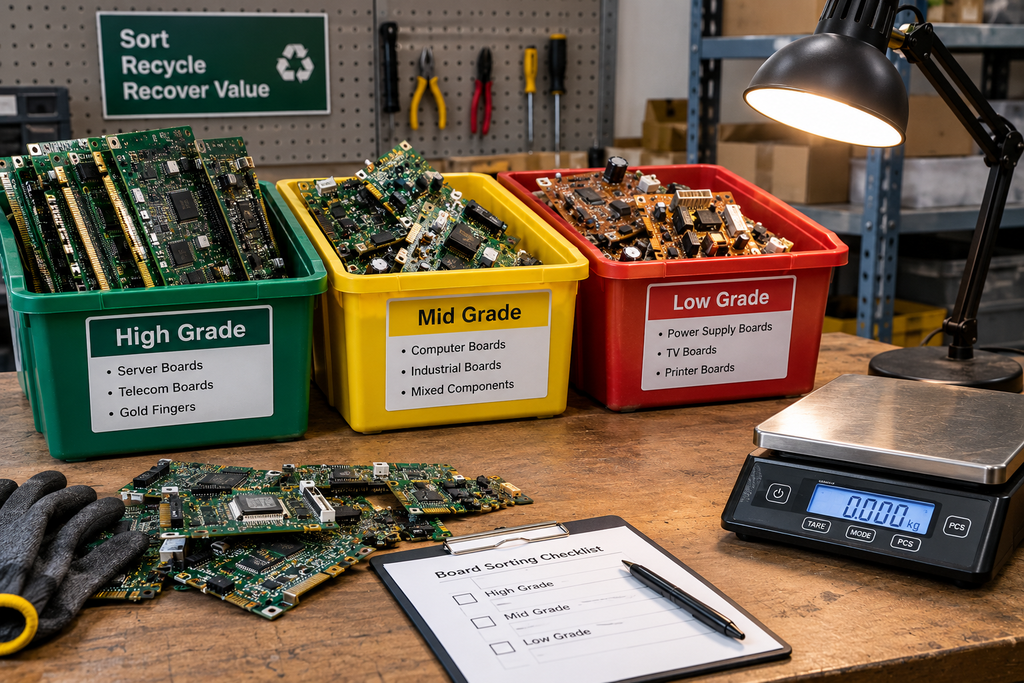
Sort circuit boards for scrap by setting up separate bins, triaging by origin, checking each board against the visual signals, removing dead weight, and weighing each grade separately. Here is the process step by step:
- Set up labeled bins: high, mid and low grade, plus a bin for anything that might hold data.
- Triage by origin: if you know the board came from a server or telecom rack, it starts in the high-grade bin.
- Check density and chips: count BGA packages and look for bare boards.
- Inspect connectors under good light: a work lamp and a jeweler’s loupe help you spot real gold plating.
- Remove dead weight your buyer does not pay for: steel brackets, plastic housings, large heatsinks and coin cell batteries.
- When unsure, grade down: put a borderline board in the lower bin so it cannot drag a higher lot.
- Weigh and photograph each bin: both speed up an accurate quote.
Sorting a large volume? Our team grades mixed loads on site through our circuit board and component recycling service.
| Not sure what grade you have? Send our team a few photos and an approximate weight, and we will give you a grade-by-grade quote based on current market pricing. Request a quote |
Should you remove CPUs, RAM and heatsinks before selling?
Whether you should remove CPUs, RAM and heatsinks depends on the buyer’s grading sheet, and this is where published advice genuinely conflicts. Some buyers grade boards populated and want them left intact. Others pay separate, higher rates for pulled processors and memory.
Here is the decision rule we give sellers:
- Remove batteries always. Coin cell batteries can trigger downgrades or rejected loads.
- Remove large heatsinks and steel when the buyer pays by board weight, since that metal dilutes the grade.
- Pull CPUs and RAM only when your buyer lists them as separate line items at a higher rate.
- Never shred, snap or burn boards. Broken fragments are hard to grade and often get paid as low grade.
Prioritize depopulating if your buyer prices components separately. Prioritize shipping populated boards if you are moving volume to a buyer who grades whole boards.
What business sellers need to check before boards leave the building
Business sellers need to check two things before scrap boards leave the building: whether any board can still hold data, and whether the buyer handles e-waste legally and responsibly.
Can a circuit board hold data?
Yes. Hard drive logic boards, motherboards with soldered flash or SSD storage, network gear and phones can all retain information. Sort these into a data bin and have them sanitized or destroyed before grading.
NIST published Special Publication 800-88 Revision 2, Guidelines for Media Sanitization, in September 2025. It frames sanitization as an enterprise program rather than a one-off wipe.
Our data destruction services follow NIST guidance and provide Certificates of Destruction for audit trails.
Why compliance matters in California
California treats many discarded electronics as hazardous waste, so dumping boards is not an option.
In a 2026 rulemaking notice, the California Department of Toxic Substances Control reported that boards it tested exceeded state thresholds for copper, lead and nickel.
Those boards came from video display devices, but the lesson applies broadly: scrap boards belong with a licensed recycler.
The US EPA recommends certified electronics recyclers for used electronics.
It names R2 and e-Stewards as the two accredited certification standards in the US. Ask any buyer for current R2 or e-Stewards status, other certifications, and downstream documentation.
The stakes are global, too. The UN’s Global E-waste Monitor 2024 found that only 22.3% of the 62 million tonnes of e-waste generated in 2022 was documented as properly collected and recycled.
Gold’n West Surplus holds ISO 14001 and ISO 45001 certifications and is WBENC women-owned, NMSDC minority-owned and HUB certified, which helps public agencies and corporations meet supplier diversity goals. For full fleet retirements, see our IT asset disposition program.
At Gold’n West Surplus, circuit boards from retired servers, computers, telecommunications equipment, and printers represent different levels of recycling value. When mixed electronic scrap is evaluated, identifying and separating boards by grade is an important step.
High-grade server and telecom boards typically contain dense integrated circuits and gold-plated connectors, while power supply and printer boards generally have different component compositions and recovery potential.
By focusing on proper identification and grading, Gold’n West Surplus helps customers understand their electronic scrap and evaluate materials more accurately for recycling
Frequently asked questions
Are green circuit boards high grade?
Not automatically. Green usually means an FR-4 fiberglass board, common in mid and high-grade equipment, but many cheap consumer boards are green too. Grade depends on what is mounted on the board: chip density, BGA packages, gold-plated connectors and equipment origin. Treat green as a hint, then check the other signals.
Is a motherboard high grade or low grade?
Most desktop and laptop motherboards are mid grade. Server and workstation motherboards, especially multi-socket boards with server-class processors, usually grade higher. Older large-socket boards often carry thicker gold plating than modern ones, which is why many buyers price them separately. Budget boards with sparse components can slip toward the low end, so check density and connectors.
Are telecom boards high grade?
Telecom boards are among the most consistent sources of high-grade scrap. Line cards, switch cards and backplanes are typically dense with IC chips and gold-plated connectors because they were built for continuous service. Some buyers split telecom into two tiers, since lower-end cards exist.
How much gold is in a high-grade circuit board?
Gold content varies by board type, age and manufacturer, so no single number applies. High-grade boards carry much more gold than low-grade boards because of dense chips, plated connectors and gold bond wires. The only reliable way to know a specific lot’s gold content is an assay (a lab analysis of a sample).
Can you sell circuit boards without sorting them?
Yes. Many buyers accept mixed loads, but unsorted material is typically paid at a lower blended rate. If time is short, pull out just the obvious high-grade server and telecom boards.
For large volumes, a buyer that grades on site saves you the labor. Our guide on where to sell scrap circuit boards compares the options.
Bottom line: a high-grade vs. low-grade circuit board cheat sheet
| If the board… | It is probably… | Do this |
| Came from a server, telecom or networking rack | High grade | Keep it separate and handle data first |
| Is covered in chips with several BGA packages | High grade | Do not mix it with anything else |
| Is a standard desktop or laptop motherboard | Mid grade | Check the buyer’s motherboard categories |
| Is brown, sparse or carries a transformer | Low grade | Bin it apart and strip steel if required |
| Might hold data | Data bin | Sanitize or destroy before grading |
Visual grading is an estimate. It works well for sorting, but it cannot replace an assay or a buyer’s own inspection, and pricing moves with metals markets.
Sort by origin, confirm with density and connectors, keep grades apart, and work with a buyer who documents everything. When you are ready, get a graded quote from Gold’n West Surplus or drop off at our Corona facility.